


The 2.7% Problem: How High-Performance Builders and Architects Win More Work
By Avi Bar, Chief Revenue Officer at Alpen
Key takeaways
- HERS-rated homes sold for about 2.7% more than comparable unrated homes in Freddie Mac's study of 2013–2017 sales. On a median-priced new home, that works out to roughly 12% more gross profit per home (illustrative math).
- High performance is now mainstream. 420,135 homes were HERS-rated in 2025, about one in three new one- and two-family homes, so the differentiation has moved up to ZERH, Phius and Passive House.
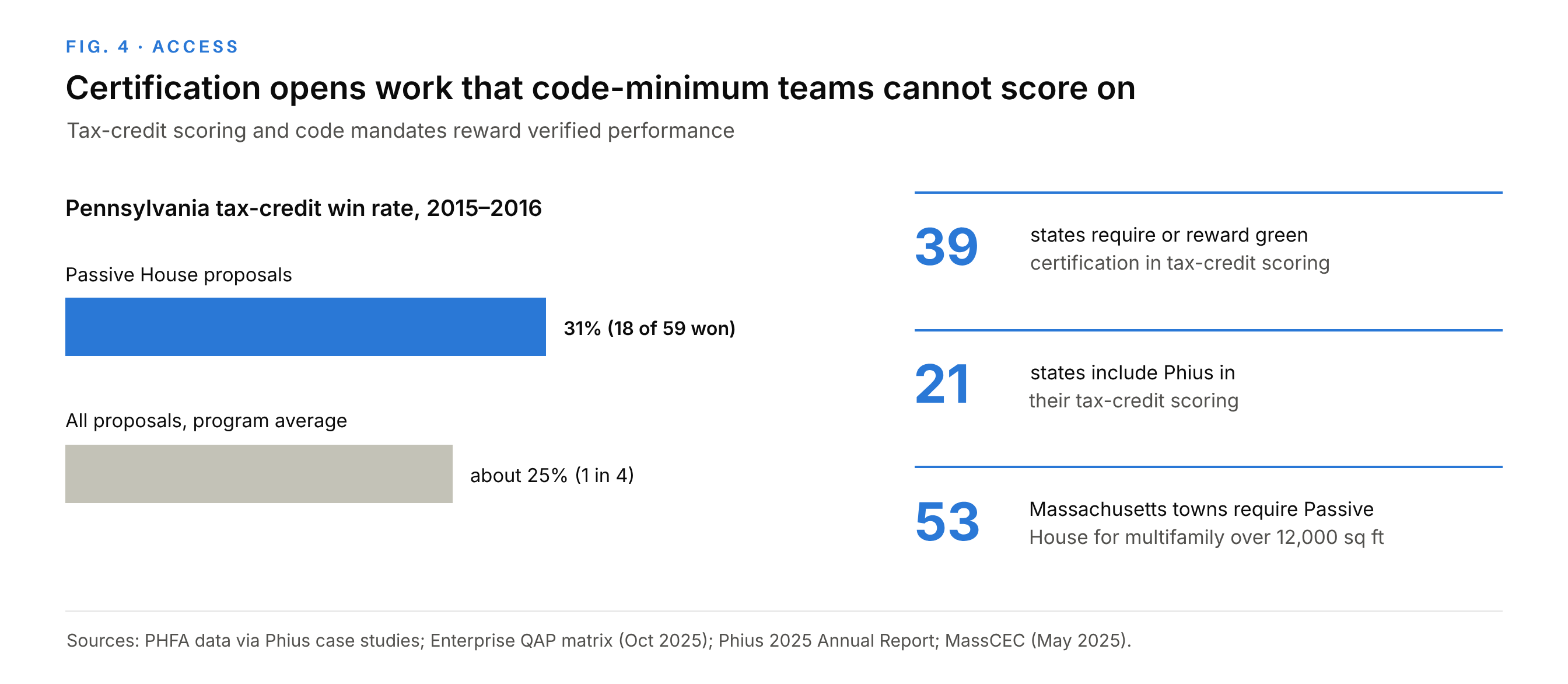
- Certification opens work others can't compete for. 39 states require or reward green certification in affordable-housing tax credit scoring, and Passive House proposals in Pennsylvania won about 31% of the time versus a 25% program average.
- Verified homes cost less after the sale. DOE's Building America program found builders cut callbacks by about half on average.
- Windows are where buyers feel performance. On a 15°F night, a U-0.20 triple-pane window's glass stays around 62°F versus 58–59°F for a code-level double-pane window.
Ask a builder whether high-performance construction is worth the effort and the conversation usually lands on one number. HERS-rated homes sold for about 2.7% more than comparable unrated homes in Freddie Mac's study of 2013 to 2017 sales. It is the largest US dataset on the question, and the number is real.
It is also the weakest part of the case. A builder looking at a 2.7% bump in a 6.5% mortgage market reasonably asks whether it covers the extra work. The better evidence sits elsewhere: in margin, in market share, in access to work that code-minimum competitors cannot score on, and in what happens after the keys are handed over.
Start with margin, not price
The median new home sold in the US in December 2025 went for $414,400. A 2.7% premium on that is roughly $11,200. Against a typical production-builder gross margin of around 22%, that is about 12% more gross profit per home before the cost of the upgrades. That math is illustrative, not a study, but it shows why a small top-line number can be a large bottom-line one.
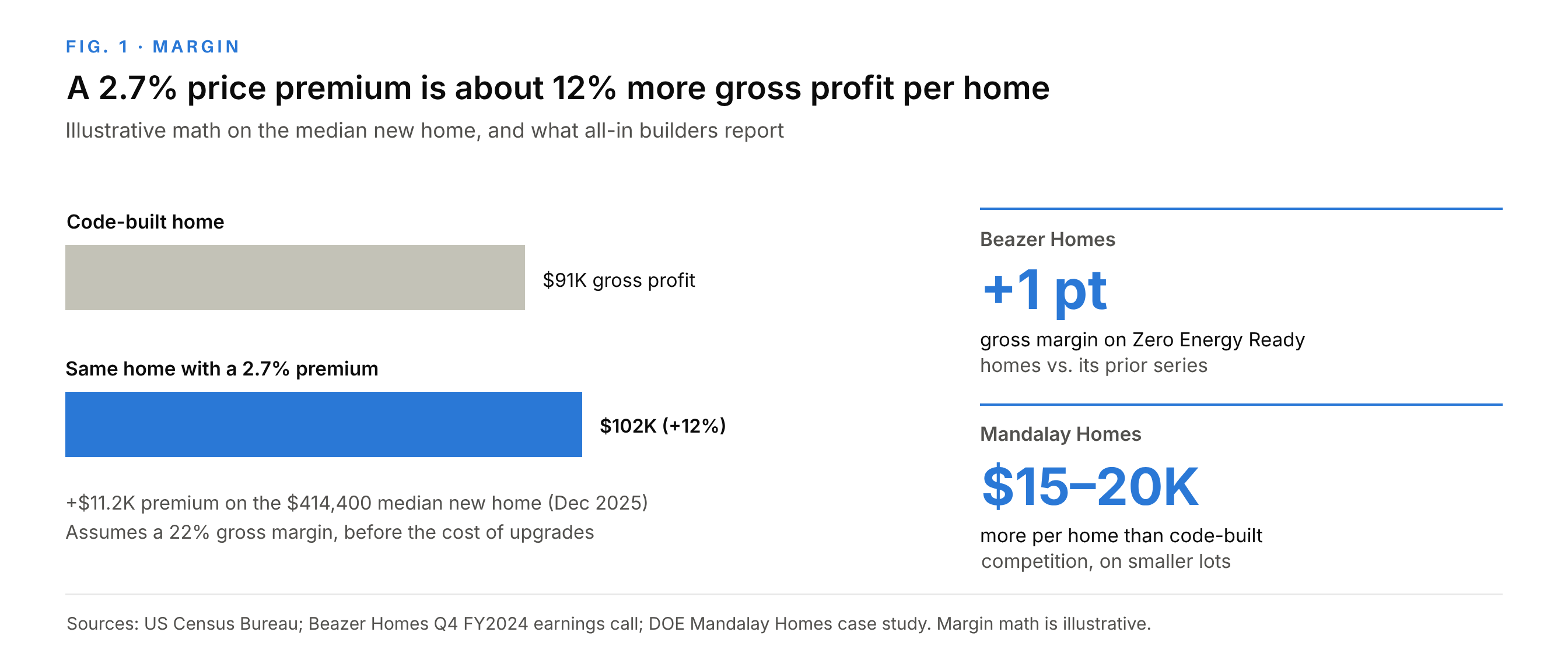
The builders who have committed to performance at scale report the same thing in plainer language. Beazer Homes, which set out to build every home to DOE Zero Energy Ready Home (ZERH) standards, told investors in late 2024 that margins on its Zero Energy Ready homes in backlog were already more than a point higher than its prior-series homes. Mandalay Homes in Arizona, an all-ZERH builder, said in a DOE case study that its homes sold for $15,000 to $20,000 more than code-built competition, on smaller lots and with less square footage.
One caution. The Freddie Mac data comes from a low-rate era. At today's rates, $11,000 of price is about $70 a month of principal and interest, and buyers feel it. That is exactly why the winners sell monthly cost of ownership instead of sticker price.
The subsidy is also gone. The federal 45L credit, worth $2,500 per ENERGY STAR home and $5,000 per Zero Energy Ready home, ended for homes acquired after June 30, 2026. Builders who used it to cover the upgrade now have to make the case on margin, comfort and access on their own.
The market already moved
High-performance building is no longer a niche to test. It is a large and growing share of what gets built.
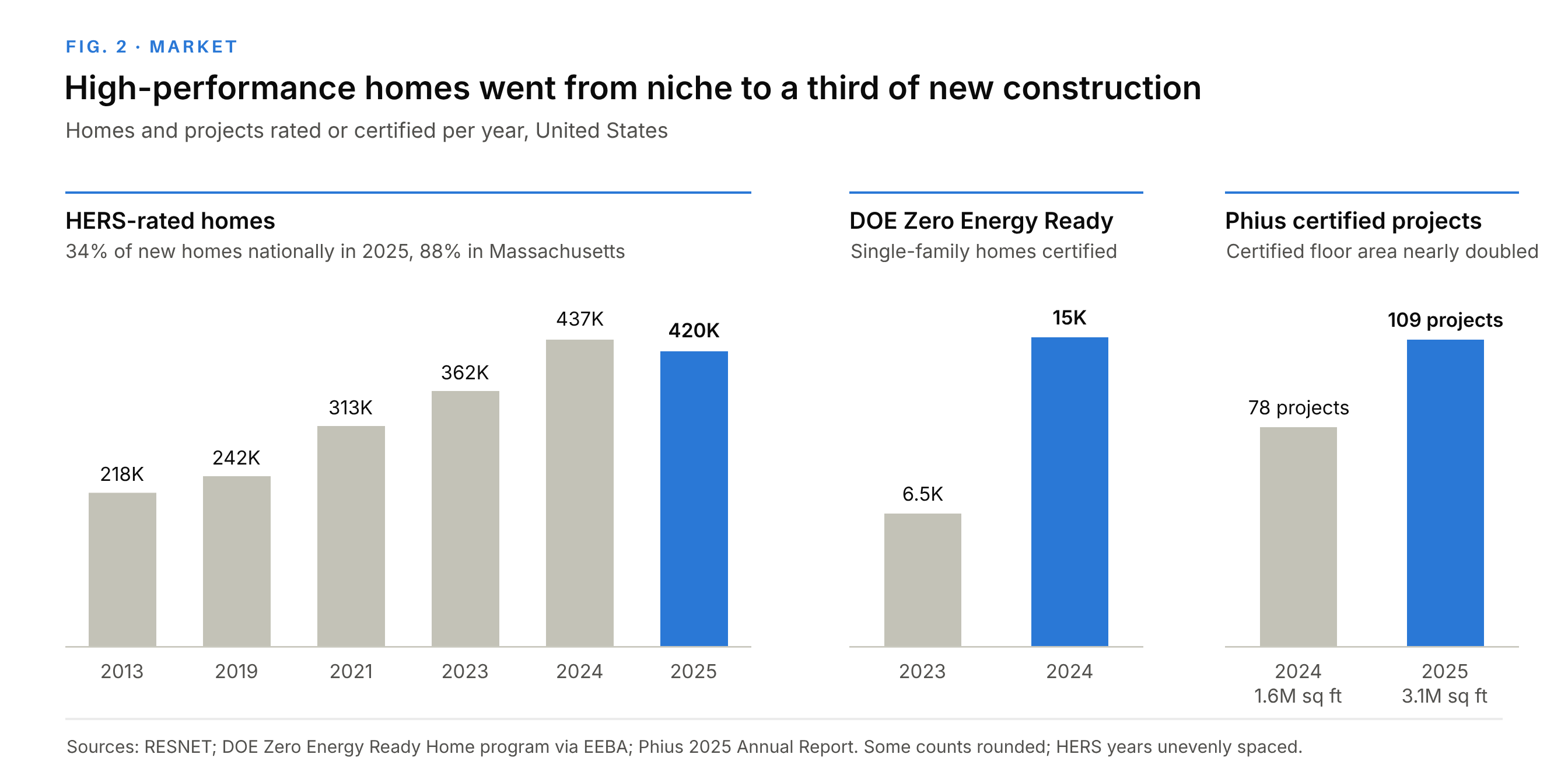
The growth shows up in every program that verifies performance, not just one. HERS ratings, the broadest measure, nearly doubled from about 218,000 homes in 2013 to 420,135 in 2025, when one in three new one- and two-family homes carried a score and the cumulative total passed 5 million. In Massachusetts the share is 88%. At the top tier the climb is steeper: DOE Zero Energy Ready certifications more than doubled in a single year to nearly 15,000 single-family homes in 2024, and Phius certified 109 projects in 2025 while its certified floor area nearly doubled to 3.1 million square feet.
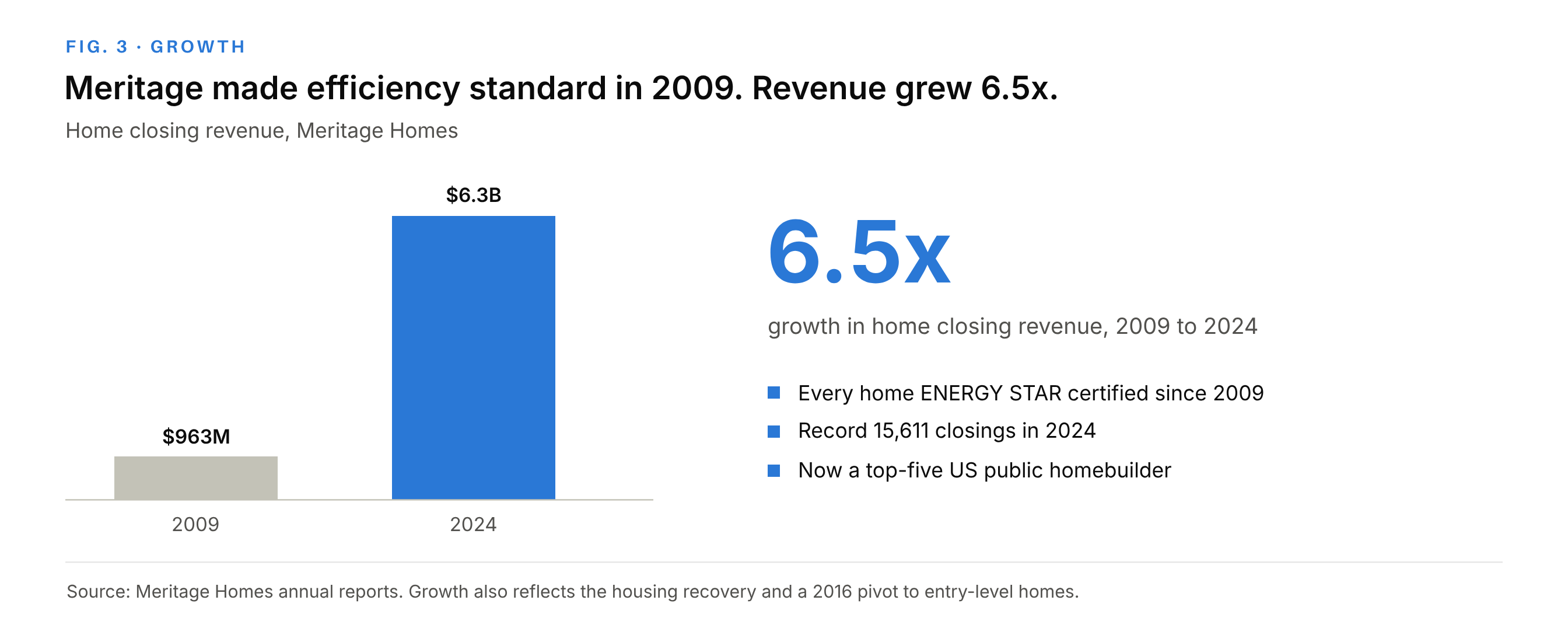
The production builders leaning hardest into performance have grown with it. Meritage Homes committed to 100% ENERGY STAR homes in 2009, when its home closing revenue was about $963 million. In 2024 it posted a record $6.3 billion on 15,611 closings, and the company itself calls energy efficiency a critical driver of that growth. The housing recovery and Meritage's pivot to entry-level homes did a lot of work too, so treat efficiency as a contributor, not the whole story.
The flip side matters. When a third of new homes carry a HERS score and most windows sold are already ENERGY STAR, being "efficient" stops setting anyone apart. The differentiation has moved up the ladder to ZERH, Phius and Passive House, where fewer teams can deliver.
Access to work others cannot score on
The strongest commercial argument for performance has nothing to do with listing price. Certification opens doors.
- Affordable housing tax credits. As of October 2025, 39 states required or rewarded green certification in their Low-Income Housing Tax Credit scoring, and 21 states include Phius.
- Pennsylvania shows how much points matter. Only about one in four tax credit applications to the Pennsylvania Housing Finance Agency gets funded. When the agency began awarding 10 of 130 points for Passive House in 2015, 59 of 179 proposals in the first two years pursued it, and 18 of those won. That is a win rate near 31% in a program that averages about 25%.
- Code mandates. In Massachusetts municipalities that adopted the opt-in Specialized Code (53 communities, about 30% of the state's population as of May 2025), multifamily buildings over 12,000 sq ft must meet Passive House. Mass Save incentives also require a certified Passive House consultant on the team.
- Land. Denver's Thrive Home Builders, which certifies every home to ZERH, credits that commitment with helping it secure lots and land position in the city's most desirable communities, according to DOE.
For architects, the signal is similar. AIA's 2024 Firm Survey found that 22% of residential construction contract value in 2023 came from buildings designed to meet or exceed a performance or sustainability rating standard. That is work a firm without the expertise struggles to win. There is no reliable public data yet on fee premiums for Passive House credentials, so the honest claim is access, not higher fees.
Lower cost after the sale
Verified performance also changes what happens after closing. DOE's Building America program found builders cutting callbacks by about half on average after adopting its whole-house approach, and one large Chicago builder saw warranty claims and callbacks fall more than 70% over four years. Thrive reported that within two years of starting a formal quality assurance program it saved about $150,000 in insurance premiums, cut variance costs by roughly $1,000 per home and shortened cycle time by 27 days.
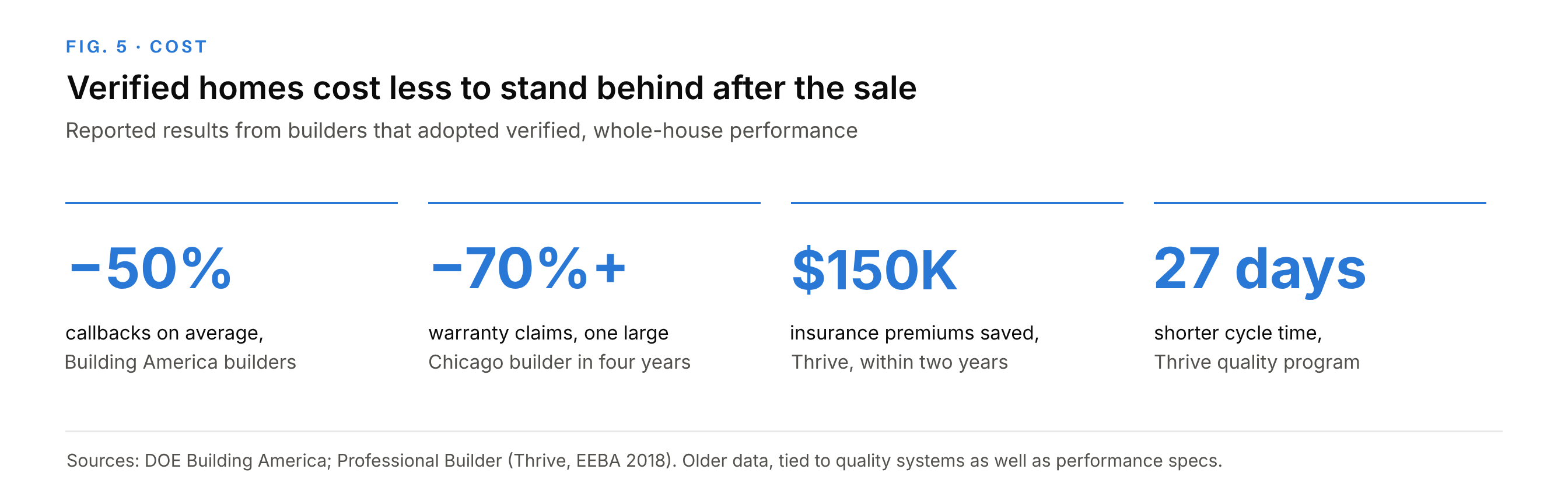
Much of that data is older and tied to quality systems as much as to the performance spec itself. The direction is consistent, though. Homes built and verified to a performance standard generate fewer comfort, moisture and HVAC complaints, and those complaints are expensive.
Lenders see the same pattern. In Freddie Mac's study of 2013 to 2017 sales, loans on HERS-rated homes showed lower delinquency rates than loans on comparable unrated homes. On the multifamily side, Fannie Mae and Freddie Mac have run green financing programs that cut loan spreads for buildings that meet efficiency thresholds. In 2018, Fannie Mae's Green Rewards program typically reduced spreads by 10 to 20 basis points, with up to 39 allowed. Program terms change, so check current pricing with a lender before counting on it.
Where windows fit
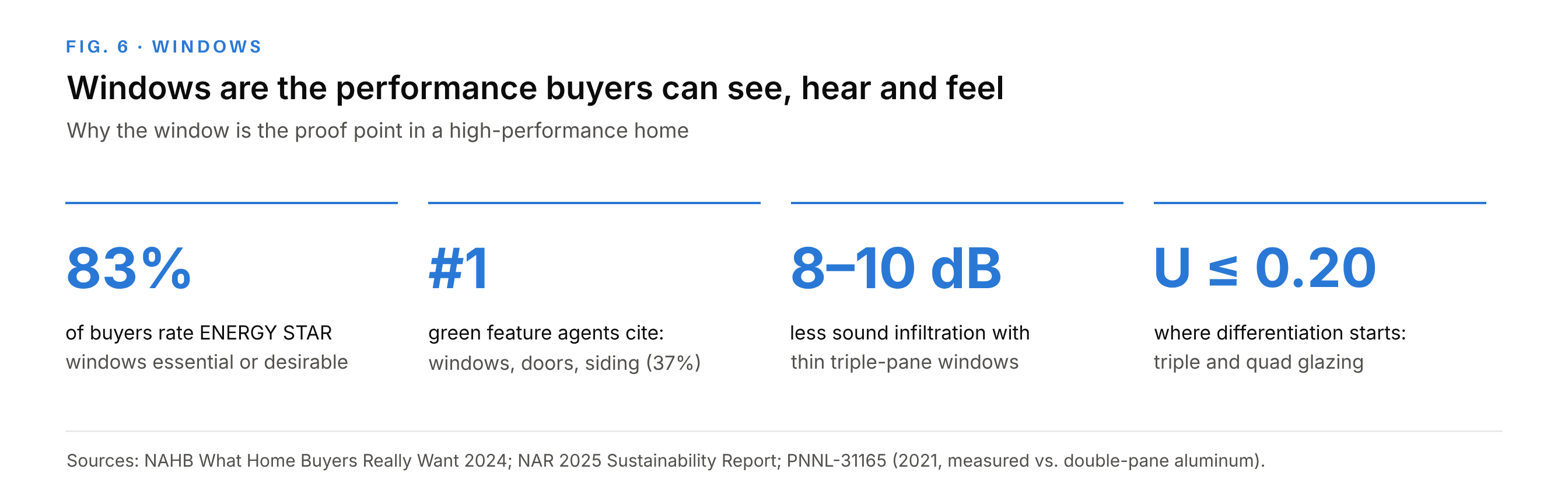
Windows are the part of the envelope buyers already understand. In NAHB's 2024 What Home Buyers Really Want survey, 83% of buyers rated ENERGY STAR windows essential or desirable, ranking them third of more than 200 features. In NAR's 2025 sustainability survey, windows, doors and siding were the most-cited green features at 37%.
That familiarity cuts both ways. Most windows sold in the US already carry an ENERGY STAR label, so the label alone wins nothing. The differentiation is in whole-window U-factors at or below 0.20, triple and quad glazing, frame performance and Passive House component certification.
The value a buyer actually feels is comfort, not kWh. On a 15°F night in a house held at 70°F, the center of a code-level low-E double-pane window sits at about 58 to 59°F. A U-0.20 triple-pane runs about 62°F, and a U-0.10 quad-glazed unit about 66°F. (These are our own center-of-glass calculations; frames and edges run colder.) Warmer glass means no cold downdraft, usable floor space right up to the window, and no condensation on the glass or the sill. Pacific Northwest National Laboratory also measured an 8 to 10 dB drop in sound infiltration with thin triple-pane windows. Its 12% heating and 28% cooling savings were measured against double-pane clear aluminum windows, so savings against a modern low-E double-pane window will be smaller. Quote them with that baseline.
Windows also carry a specific risk. They are a visible line item and the easiest thing to value-engineer out. When they go, the HERS points, the certification and the comfort story often go with them. The reverse also holds. Under the energy code's performance and total-UA compliance paths, a better window counts toward the whole envelope, which gives designers room to trade it against other components instead of treating it as a stand-alone upgrade. And the mechanical savings only show up when the mechanical engineer sizes equipment to the envelope that is actually going in, so the window decision belongs in the same room as the HVAC design.
What the winning teams do
- Make performance the base spec. Triple glazing sold as a design-center option rarely sells. Built into the base home and the base financing, it does.
- Publish the number. A HERS score, ZERH label or Phius certificate turns a claim into something an agent, an appraiser or a housing agency can use.
- Sell the monthly cost and the comfort. Buyers buy payments. Pair the mortgage with the utility bill and show the quiet, warm room next to the glass.
- Bring the mechanical engineer in early. Envelope and HVAC decisions made together are where first-cost parity comes from.
- Hand appraisers the paperwork. Most builders say appraisals rarely reflect green value. A completed green and energy-efficient addendum with the ratings and NFRC labels attached gives the appraiser something to work with.
The 2.7% premium is real. It just is not the reason the best builders and architects do this work. They do it because it widens the work they can win and lowers what it costs to deliver it. Windows are where that story becomes something a buyer can see and feel.
Planning a high-performance project?
Bring Alpen in before the window schedule gets value-engineered. Our team works with architects, engineers and builders from schematic design onward to compare glazing options, U-factors and cost, and to line the window spec up with your HVAC and certification targets.
- Schedule a design consultation with our team for your next ZERH, Phius or Passive House project.
- Download specs and technical details from the Alpen Architectural Design Manual, or grab Revit and CAD files from our BIM library.
- Order a sample or request a quote.
Sources
- RESNET, HERS Rated Homes in 2025 and 5 Million HERS Rated Homes (2026)
- Insulation Institute; Ekotrope (historical HERS counts)
- EEBA, Exponential Growth for the Zero Energy Ready Home Program (2025)
- Phius 2025 Annual Report and 2025 Year in Review
- Freddie Mac via RESNET, HERS Homes Sell for More Than Comparable Unrated Homes (2019); ProBuilder, HERS-Rated Homes Sell Better Than Unrated Homes; Northmarq, Fannie Mae green lending (2018)
- US Census Bureau, New Residential Sales, December 2025
- Beazer Homes Q4 FY2024 earnings call; DOE Mandalay Homes case study; DOE Thrive Home Builders case study
- Meritage Homes 2009 Annual Report, 2024 results, 40th anniversary release
- Tax Credit Advisor, Balancing Green QAP Standards (Enterprise QAP matrix, October 2025)
- Passive House Accelerator; Nettleton and Griffith PHFA case studies (Phius)
- MassCEC, Passive House Design Challenge; Mass Save Passive House Incentives
- AIA Firm Survey Report 2024
- DOE Building America, Reduced Callbacks; Professional Builder, QA Programs
- NAHB What Home Buyers Really Want 2024; NAR 2025 Residential Sustainability Report
- PNNL-31165 (2021), thin triple-pane window Lab Homes study


